The course
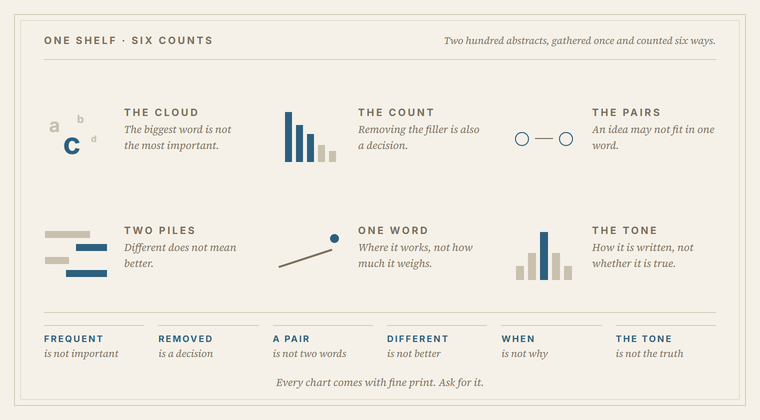
A pile of text says nothing on its own. It has to be counted, and counting is a decision: what counts as a word, what gets thrown away, what is compared against what. This course makes six of those counts in front of you, one per lesson, over a single shelf of two hundred scientific abstracts that is gathered once in the first lesson and reused by the five that follow. The first draws a word cloud in two minutes and hands you the pleasure of seeing something. The second takes that same cloud apart and rebuilds it honestly, and that correction is the whole lesson, because the pretty picture and the honest picture are not the same picture. From there each lesson adds a rung: pairs of words instead of single words, two piles set face to face, one word followed through time, and at the end the pile measured by its tone. Every chart arrives with a line on screen saying what that picture cannot tell you, and by the end those six lines form a board that is the real result of having taken the course. Nothing you count here proves a cause: a count says what repeated, not why; a comparison says how two piles differ, not which one is right. That limit is said out loud in every lesson, because it is where most public text analysis breaks.
Curriculum
-
-
(Included in full purchase)
Start here: how this course works
-
(Included in full purchase)
-
-
(Included in full purchase)
A01 · The Shelf and the Cloud
-
(Included in full purchase)
A02 · Counting Honestly
-
(Included in full purchase)
A03 · Ideas Travel in Pairs
-
(Included in full purchase)
A04 · Two Piles, Face to Face
-
(Included in full purchase)
A05 · One Word at Work
-
(Included in full purchase)
A06 · How the Pile Feels
-
(Included in full purchase)
You could learn this from the people selling you the chart.
Most tools that draw a word cloud or score a sentiment hand you the picture and stay quiet about what the picture will not hold. Their business succeeds when you share it. This course succeeds when you can read a chart and say what is missing from it, including a chart you made yourself, which is the lesson no tool can afford to teach. There is no platform behind the curtain here: everything runs in Python notebooks you keep, with the code in view and the stop-word list named line by line, because that is where it is decided what counts.

Diego Bonilla, Ph.D.
Full Professor of Communication Studies The work I do has changed its name four times. When I started teaching it, in the late nineties at Syracuse, it was called computer literacy. Then it was information literacy, and I created a university course on privacy that I have now taught for over twenty years. Then it was digital literacy: in 2007 and 2009 I served on the ETS committee at Princeton that set the passing standard for the national assessment, back when the phrase needed explaining, and from 2014 to 2016 I was the California State University system's ICT Literacy Ambassador. Now it is called AI literacy, and within a year of ChatGPT's release I was directing the faculty community on AI literacy at my university. Four names, one job: helping people not be at the mercy of the newest machine. I have also worked on the other side of the counter. In 2000 I began making films that a machine assembles, differently for every viewer; the first of them took first prize at the Moscow International Film Festival, two decades before the industry shipped a generative model. A generative video poem I made with a UNAM poet was selected for the field's definitive anthology and exhibited in Sacramento and Istanbul, and in 2025 my VR work took an award at an AI film festival. And I study these systems as a scholar: my doctorate measured what a machine can infer about a person from the traces they leave, and my recent published work is on AI and elections, and on how these models represent cultures that are not the ones they were trained on. The systems this course explains run under my hands daily, in production; they made the pictures and the voices you will see inside. The vendors began teaching AI literacy two years ago, because before that there was nothing to sell. I am not against them. I am simply not one of them, and that is the difference you are buying. Ph.D., Syracuse University · Full Professor, Sacramento State · ETS iSkills committee, Princeton, 2007 and 2009 · CSU ICT Literacy Ambassador, 2014-2016 · Directed the AI Literacy faculty community, 2023-2026 · First prize, Moscow International Film Festival, for a machine-assembled film · Published scholarship on AI, elections, and cultural representation, in two languages
The receipts
A course about distrusting charts should survive having its own charts checked. Every figure on screen came out of the run you are watching, not an earlier run and not an example: the same shelf, the same query, the same day. The shelf is gathered once and reused across all six lessons, because a pile gathered twice is two piles, and a number that changes between them is not a finding, it is the date. In the first lesson I bet out loud on which word would dominate the cloud, and lost in front of you: the largest word was the query itself. That stayed in the lesson. And every lesson closes with a notebook that runs, the skill written out in words so you can ask an AI for the technique, and the shelf itself in a file, so the next chart is yours and not mine.
The six lessons, and the board of fine print at the end.
Six ways of looking at a pile of text, each with the chart it produces and with what that chart cannot show you.