The course
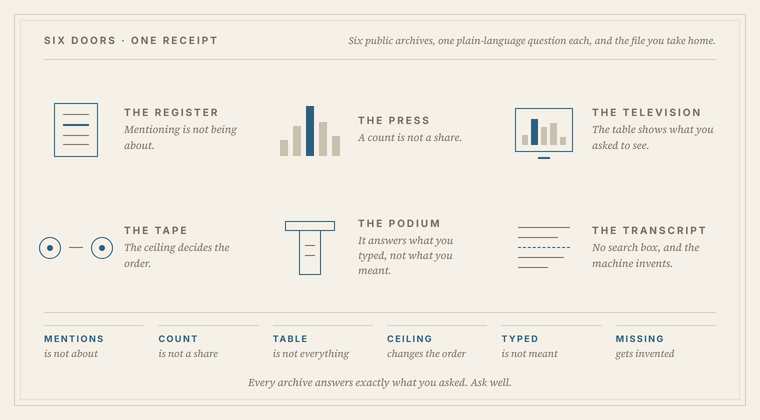
The public archives of the United States wait for no one: the government's official record, twenty years of a news network's own transcripts, every public word of every president since 1789, television monitored hour by hour. They are open, and almost nobody walks in, because the door is an API and an API looks like a programmer's business. This course opens nine of those doors in front of you, one per lesson. In each one you write the question in plain words, an AI writes the code, the code runs in Colab, and the answer comes back as a file you own, with the date and the query written inside it. Six of the nine archives ask for no account and charge nothing; the other three give their key away, and GovInfo's two windows open with the same one. What all of them ask for is judgment: the time window, the word, the row ceiling and the collection are your decisions, and every lesson shows on screen the moment a careless one changes the answer. A column that comes back empty, a table that stops at thirty-two rows, a machine that invents a fact the page never held: none of it was edited out. It was worked out in front of you, because that is where the technique lives.
Curriculum
-
-
(Included in full purchase)
Start here: how this course works
-
(Included in full purchase)
-
-
(Included in full purchase)
I01 · The Federal Register API
-
(Included in full purchase)
I02 · The Media Cloud API
-
(Included in full purchase)
I03 · The GovInfo Congressional Record API
-
(Included in full purchase)
I04 · The GovInfo Compilation of Presidential Documents API
-
(Included in full purchase)
I05 · The Arctic Shift Reddit Archive
-
(Included in full purchase)
I06 · The GDELT TV API
-
(Included in full purchase)
I07 · The Internet Archive TV News Archive
-
(Included in full purchase)
I08 · The American Presidency Project
-
(Included in full purchase)
I09 · The CNN Transcripts Archive
-
(Included in full purchase)
You could learn this from the people selling you the access.
The platforms that resell public data hand you a polished chart and keep the query, the ceiling and the date to themselves. Their business succeeds when you depend on them. This course succeeds when you can go to the original archive, ask in your own words, and say where every number came from, including the numbers that contradict you. There is no middleman here: every lesson runs against the archive itself, with the code in view, and goes home in a notebook you can change.
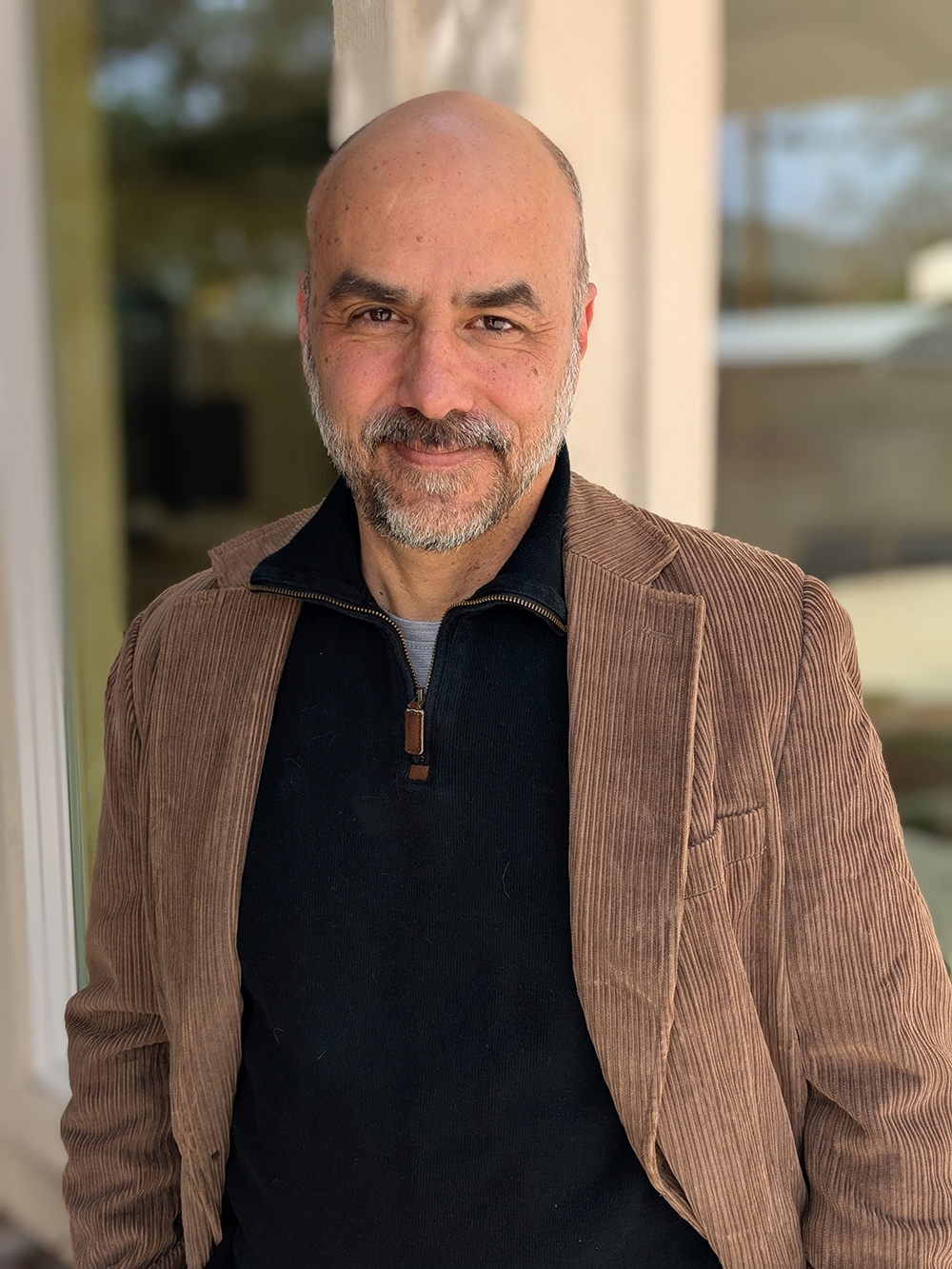
Diego Bonilla, Ph.D.
Full Professor of Communication Studies The work I do has changed its name four times. When I started teaching it, in the late nineties at Syracuse, it was called computer literacy. Then it was information literacy, and I created a university course on privacy that I have now taught for over twenty years. Then it was digital literacy: in 2007 and 2009 I served on the ETS committee at Princeton that set the passing standard for the national assessment, back when the phrase needed explaining, and from 2014 to 2016 I was the California State University system's ICT Literacy Ambassador. Now it is called AI literacy, and within a year of ChatGPT's release I was directing the faculty community on AI literacy at my university. Four names, one job: helping people not be at the mercy of the newest machine. I have also worked on the other side of the counter. In 2000 I began making films that a machine assembles, differently for every viewer; the first of them took first prize at the Moscow International Film Festival, two decades before the industry shipped a generative model. A generative video poem I made with a UNAM poet was selected for the field's definitive anthology and exhibited in Sacramento and Istanbul, and in 2025 my VR work took an award at an AI film festival. And I study these systems as a scholar: my doctorate measured what a machine can infer about a person from the traces they leave, and my recent published work is on AI and elections, and on how these models represent cultures that are not the ones they were trained on. The systems this course explains run under my hands daily, in production; they made the pictures and the voices you will see inside. The vendors began teaching AI literacy two years ago, because before that there was nothing to sell. I am not against them. I am simply not one of them, and that is the difference you are buying. Ph.D., Syracuse University · Full Professor, Sacramento State · ETS iSkills committee, Princeton, 2007 and 2009 · CSU ICT Literacy Ambassador, 2014-2016 · Directed the AI Literacy faculty community, 2023-2026 · First prize, Moscow International Film Festival, for a machine-assembled film · Published scholarship on AI, elections, and cultural representation, in two languages
The receipts
A course about evidence should survive being asked for its own. Every figure on screen came out of the run you are watching, with the query and the date saved into the same file you take home. When an archive answered badly, that stayed in the lesson: the empty column from the Federal Register, GDELT's silent ceiling, the fact an AI invented about a CNN transcript. All nine lessons of the redesign are here, each one passed the same check before it came in, and the price does not move. And every lesson closes with a notebook that runs, the skill written out in words so you can ask an AI for the technique, and the run's results in a file, so the next question is yours.
Nine open archives, and a receipt for every answer.
Nine lessons, each with a public archive, the question in plain words, the code the AI wrote, and what that archive cannot tell you.